

By Stephanie Holt, Director of Learning and Teaching, DSB International School, Mumbai, India
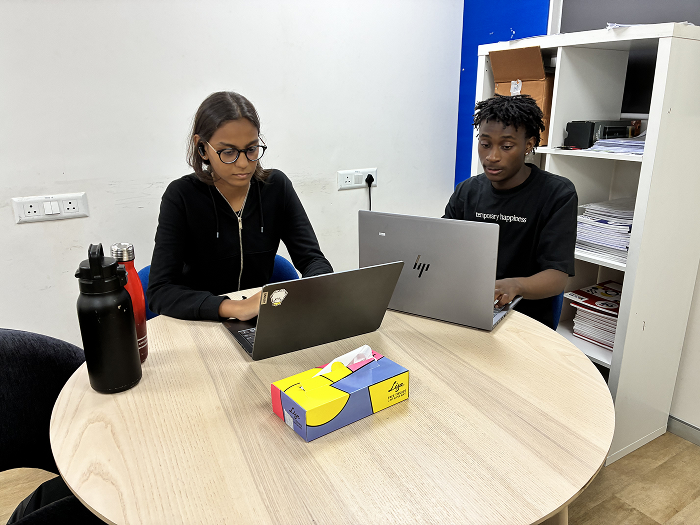
When I examine how education is evolving, it’s clear that artificial intelligence is no longer a future consideration for schools; it is already shaping how students learn, think, and demonstrate understanding. At DSB International School, our work with AI has been guided by a simple principle: technology must serve pedagogy, not the other way around. In an IB context, this means using AI to strengthen criterion-based assessment, deepen Approaches to Learning (ATL) skills, and uphold the IB’s commitment to equity, integrity, and conceptual understanding.
Personalised learning within a criterion-based IB framework
One of the most powerful affordances of AI lies in its ability to support personalised learning without compromising shared standards. In the Diploma Programme, where assessment is criterion-referenced, this alignment matters.
AI tools such as Gemini allow students to receive individualised formative feedback aligned explicitly to DP criteria. For example, in a DP English class, students may submit a draft paragraph and ask Gemini to identify where analysis is descriptive rather than analytical in relation to Criterion A. Students then use this feedback to annotate their work, identify gaps, and plan revisions. Importantly, the AI does not “improve” the writing; it highlights patterns, prompting students to make decisions themselves.

This process strengthens key ATL skills, particularly self-management (reflection and organisation) and thinking skills (analysis and evaluation). Students are not working towards a model answer but are learning how to interpret criteria, monitor their progress, and act deliberately on feedback, skills that transfer directly to summative assessment and post-school learning.
Automation that supports effective teaching, not shortcuts
For teachers, AI has helped reduce cognitive and administrative load in ways that align with the IB’s Approaches to Teaching, particularly teaching that is informed by assessment and focused on effective feedback.
In our small DP school, where teachers often manage entire subjects, AI can support tasks such as identifying common misconceptions across drafts, grouping students by feedback needs, or preparing differentiated scaffolds ahead of lessons. This allows teachers to invest more time in conferencing, targeted instruction, and reflection. The human interactions that matter most.
For example:
- DP Maths AI HL:
After using Gemini to identify recurring issues in students’ use of technology (such as inappropriate graphing windows or misinterpretation of regression outputs) across draft explorations, the teacher groups students by conceptual need rather than attainment. Class time is then used for focused conferencing, where students justify mathematical decisions and interpretations, instead of the teacher repeatedly correcting technical errors.
- DP Biology:
Gemini is used to scan IA drafts and identify common misconceptions in data processing and conclusion writing. With these patterns identified in advance, the teacher designs a short targeted mini lesson on evaluating anomalies and uncertainty, freeing class time for one-to-one discussions with students about the scientific reasoning behind their conclusions.
- DP History:
Students use Gemini to self-check whether their essay plans address all parts of the prescribed question. This allows the teacher to spend lesson time in reflective conferences, challenging students to justify their choice of case studies and historiography in relation to Criterion B, rather than correcting structural issues that students could have identified independently.
Crucially, AI is not used to generate grades or final judgments. Professional judgment remains central, ensuring that assessment remains valid, reliable, and grounded in subject expertise.
Building critical AI literacy through ATL skills
At DSB, we treat AI literacy as an extension of ATL development, not a technical add-on. Students are explicitly taught that AI outputs are not authoritative, neutral, or complete.
In practice, this means designing learning tasks where evaluation, not production, is the goal. For instance, DP students in Language and Culture may use Gemini to generate multiple interpretations of a global issue or theoretical concept, then apply structured prompts to interrogate the output:
- Which perspectives are prioritised or missing?
- What assumptions underpin this response?
- Where does the explanation oversimplify or generalise?
Students then compare AI-generated responses with course texts, teacher input, and peer discussion. This foregrounds critical thinking, metacognition, and ethical reasoning, aligning closely with ATL thinking and research skills.
Assessment in these tasks focuses on the quality of student judgment, not the polish of the final product. The learning happens in deciding what to keep, adapt, or reject.
Inclusivity, multilingualism, and equitable access
AI has also played a significant role in supporting inclusive access to the DP curriculum, particularly in multilingual contexts.
In Language B and other DP subjects, students use Gemini to create bilingual glossaries, rephrase task instructions, or generate parallel explanations of complex concepts at different levels of linguistic complexity. This allows students to engage with demanding academic content while continuing to develop language proficiency, without lowering expectations.
Similarly, in Extended Essay supervision, AI-supported graphic organisers and planning frameworks help students structure research questions, organise sources, and map arguments before writing. These scaffolds are transferable across subjects and particularly beneficial for students who struggle with executive functioning or confidence. Used intentionally, AI supports independence rather than advantage, helping level the playing field rather than widen gaps.
For students with ADHD, managing cognitive load is often a significant barrier to sustained engagement, particularly in the Diploma Programme where reading demands, abstract concepts, and extended tasks can be overwhelming. At DSB, tools such as NotebookLM have supported these students by allowing them to work with bounded, teacher-approved sources rather than open information spaces. Students can upload key texts, teacher slides, or research extracts and use the tool to generate structured summaries, videos, podcasts, guiding questions, or concept maps. This reduces extraneous cognitive load by helping students focus on what matters most, while preserving the intrinsic challenge of the task. In practice, this has enabled students to sustain attention for longer periods, plan more effectively, and engage more confidently in conferencing with teachers. The impact aligns closely with IB ATL self-management skills, particularly organisation, time management, and reflection, supporting access without lowering academic expectations.
Ethics, integrity, and the traffic-light approach
Ethical use of AI is non-negotiable in an IB school. At DSB, we use a traffic-light system to make expectations explicit and developmentally appropriate.

Picture generated by Nano Banana.
For example, in any DP subject class, students may use Gemini in the “green zone” to clarify task instructions or generate planning questions. Before submitting work, they apply the traffic-light framework to review their AI use and annotate their draft accordingly. A student might note that AI helped them organise ideas but that all analysis and writing decisions were their own. The students understand that a red traffic light indicates that they are not allowed to use AI to generate text which they then pass off as their own. This reflection becomes part of the learning process, reinforcing academic honesty and transparency.
All AI-supported work receives teacher feedback, ensuring that learning remains relational and accountable. AI is treated as a supervised learning support, not a private space or shortcut.
Safeguarding underpins all of this work. Students use school-managed Gemini accounts, with explicit teaching around data privacy, digital footprints, and consent. Human oversight remains central at every stage.
Advice for IB schools exploring AI
From our experience, a few principles stand out:
- Start with pedagogy, not tools: Clarify what learning problem AI is addressing.
- Anchor AI use in IB frameworks: DP criteria, ATL skills, and Approaches to Teaching provide a strong foundation.
- Teach judgment, not dependency: Design tasks where students must evaluate, not accept, AI output.
- Make ethics visible: Clear guidance builds trust with students, staff, and parents.
- Start small and iterate: Pilot, reflect, refine, then scale.
Takeaways
- AI can strengthen criterion-based assessment when used formatively
- Personalisation and high standards can coexist
- ATL skills are the natural home for AI literacy and AI co-creation
- Inclusion and multilingual access must be intentional
- Ethics, transparency, and safeguarding are essential
When AI is used thoughtfully, it becomes a powerful partner in IB classrooms. AI use in our school is not replacing teachers or thinking, but amplifying feedback, access, and reflection. The challenge is not whether to engage with AI, but how deliberately we choose to do so.
