

This July, representatives from the International Baccalaureate (IB) contributed to “Evaluation for Equity: Transforming Learning Through Practice,” a thought leadership symposium held in Bogotá.
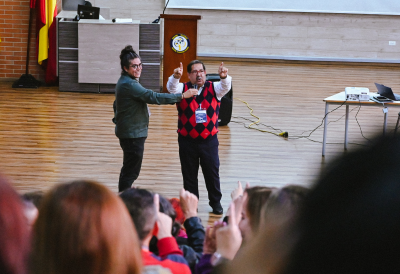
The symposium formed part of a broader learning cycle co-organized by educational institutions in Colombia and Peru, with support from UNESCO’s Participation Programme. Over 150 teachers, principals, researchers, and IB and non-IB public schools came together to reimagine academic evaluation as a driver of equity in education.
The IB played a key supporting role in the design and facilitation of the symposium, working alongside the Secretary of Education of Bogotá, the Institute for Educational Research and Pedagogical Development (IDEP) of Colombia, the Ministry of Education of Peru, and the Directorate of Basic Education for Students with Outstanding Performance and High Achievement (DEBEDSAR) of Peru.
This was an opportunity for key educational leaders to provide their own knowledge and experience as part of a genuine dialogue, seeking to build a vision of evaluation that can serve a region experiencing systemic challenges in education.
This event is part of an ongoing learning cycle launched in May 2025, where the IB co-organised a series of five workshops and two plenary sessions, consolidating proposals and practices to advance the understanding of assessment in Latin America. Themes of the workshops included the role of the teacher in formative evaluation and multilingualism, human-centered AI in education, and understanding each student’s learning level to guide teaching.
From the Department of Curriculum Design Collaboration, Aldo Anzures led the coordination of this cycle alongside Luis Eduardo Rivas, Manager for the Development of Ibero-America. Together they sought to demonstrate that transforming evaluation requires shared vision, contextualized practice, and open communication.
In taking part, the IB showed its shared commitment to consolidating practices, learnings, and plans of action that will strengthen formative evaluation as an evolving practice, adapted to different contexts and dedicated to equity.
 contributed to “Evaluation for Equity: Transforming Learning Through Practice,” a thought leadership symposium held in Bogotá. )